
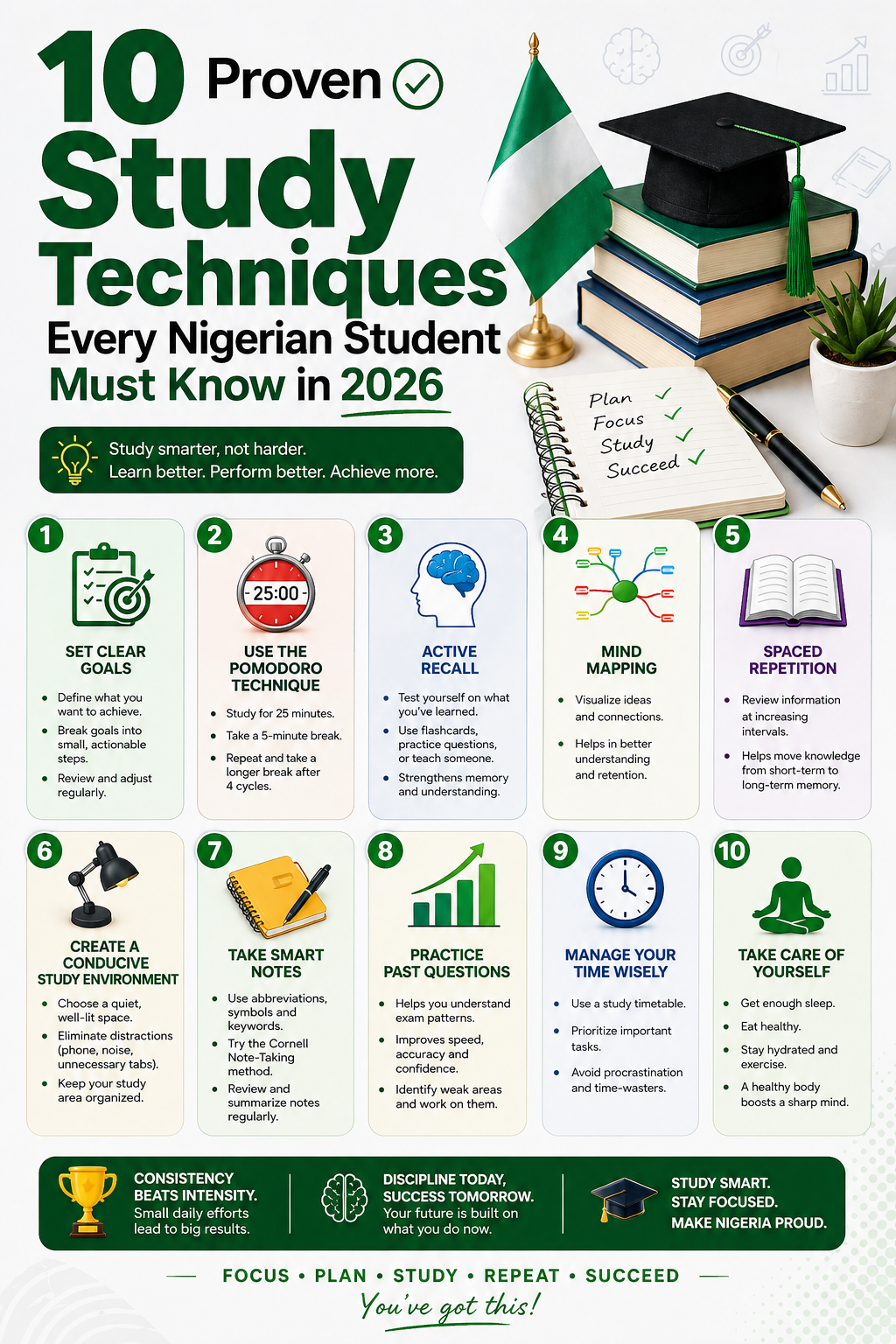
10 Proven Study Techniques Every Nigerian Student Must Know in 2026
Nigerian Students Are Failing Exams Because of This One Mistake (And It’s Not What You Think) You’ve been lied to….
Nigerian Students Are Failing Exams Because of This One Mistake (And It’s Not What You Think)
You’ve been lied to.
Everyone told you the secret to passing JAMB, WAEC, and NECO is to read more. Read earlier. Read all night.
But here you are — tired, anxious, and still not confident walking into that exam hall.
What if the problem isn’t how much you study… but how you study?
The truth is brutal: reading without strategy is just expensive sleep deprivation. You burn hours, you feel productive, and then the questions show up on paper and your mind goes blank.
That ends today.
Here are 10 study techniques that neuroscience, top students, and exam results all agree on. Master these and you won’t just pass — you’ll dominate.
1. Stop Reading. Start Recalling.
Here’s the uncomfortable truth: rereading your notes feels like studying, but your brain barely registers it.
Active Recall flips the script. After reading a page, close the book and try to say — out loud — everything you just learned. Struggle to remember it. That struggle is literally your brain building stronger memory connections.
Try it: Read one topic. Close the book. Explain it as if you’re teaching a friend. What you can’t explain, you don’t yet know.
2. The 25-Minute Rule That Changes Everything
Six hours of tired reading = less retained than two hours of sharp, focused studying.
The Pomodoro Technique forces your brain to stay switched ON:
- Study hard for 25 minutes
- Rest completely for 5 minutes
- After 4 rounds, take a 20-minute break
No phone checking during the 25. No “just one message.” The break only works if the work was real.
3. If You’re Copying Notes, You’re Wasting Time
Copying is for printers. You’re a human brain — use it.
After reading a concept, rewrite it in your own words from memory. Use your own examples. Draw your own diagrams. If you can only reproduce the textbook’s exact sentences, you haven’t learned it — you’ve memorised words you don’t own.
4. Past Questions Are Cheat Codes (Legal Ones)
JAMB, WAEC, and NECO examiners are not creative people. Questions repeat. Patterns repeat. Traps repeat.
Students who practice past questions don’t just revise — they decode how the exam thinks. They walk into the hall knowing exactly the kind of question coming at them.
Start with the last 5 years of past questions for every subject. If you’re not doing this, you’re preparing blindfolded.
5. Your Brain Has a Storage Limit Per Session — Work With It
No matter how motivated you are at 10PM, your brain’s ability to store new information drops dramatically after 90+ minutes of straight studying.
Study in short, focused blocks. 45 minutes of real concentration beats 3 hours of unfocused reading every single time. The goal isn’t to sit at a desk for long — it’s to transfer knowledge into long-term memory. Short sessions do that better.
6. Study Groups: Power Tool or Time Waster?
Study groups can 2× your understanding — or 0× it, depending on how you run them.
Good study groups: Quiz each other. Debate answers. Explain topics out loud. Hold each other accountable.
Bad study groups: Gist, laugh, check phones, and wonder where 4 hours went.
Choose carefully. One strong study partner is worth more than five distracted ones.
7. Vague Goals Produce Vague Results
“I want to read today” is not a goal. It’s a wish.
“I will complete 3 topics in Chemistry and solve 30 Physics past questions before 6PM” — that’s a goal.
Specific targets create urgency. Urgency creates focus. Focus creates results. Write your goals down before every single study session.
8. Your Phone Is Designed to Steal Your Attention
Instagram, WhatsApp, TikTok — they are engineered by teams of PhDs to hijack your focus. You are fighting billion-dollar technology every time you try to study with your phone next to you.
Put it in another room. Turn on airplane mode. Use apps like Forest or Cold Turkey to block distractions during sessions.
Your future self — the one holding that result — will thank you.
9. The Best Test of Whether You Know Something
Teach it.
Find a younger sibling, a classmate, a wall — it doesn’t matter. Explain the topic from scratch. The moment you stumble, you’ve found a gap in your understanding.
This technique, called the Feynman Technique, is how Nobel Prize winners study. If you can explain it simply, you understand it deeply.
10. Sleep Is Not Laziness — It’s Part of Studying
This one will surprise you: the learning doesn’t happen during study. It happens after, when you sleep.
Sleep is when your brain replays, organises, and locks in everything you studied. Students who pull all-nighters are literally erasing the work they just did.
Aim for 7–8 hours. A well-rested brain absorbs 40% more than an exhausted one.
The Honest Truth About Passing Exams
JAMB, WAEC, and NECO don’t reward the student who read the most pages. They reward the student whose brain can retrieve information under pressure.
These 10 techniques are not theory. They are the difference between students who hope they passed and students who know they did.
One Final Thought
The student who studies 2 focused hours daily using the right methods will outperform the one reading randomly for 10 hours — every single time.
Start with just one of these techniques today. Tomorrow, add another. In 30 days, your study game will be unrecognisable.
Your result is already being written. Make sure it’s the one you want.
This version hooks with a bold challenge, uses direct address throughout, builds tension between what readers think is true and what actually works, and closes with urgency and identity-level motivation — things that get Nigerian students to keep reading and share. Want me to also turn this into a Facebook post or YouTube script?